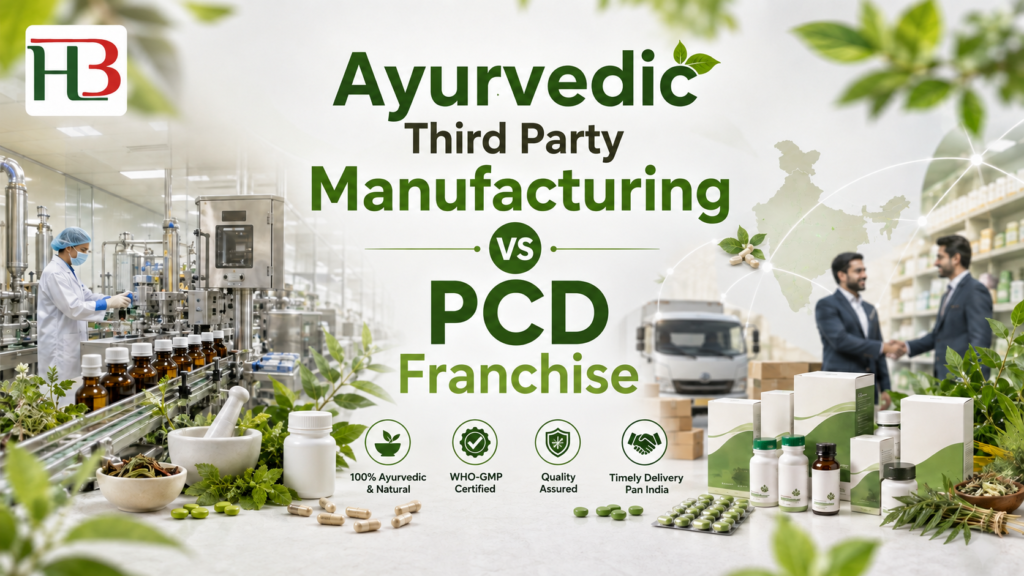
The Ayurvedic healthcare industry in India is creating new opportunities for entrepreneurs, distributors, healthcare professionals, and business owners who want to enter the herbal and Ayurvedic products market. But before starting, one important decision needs to be made: Should you choose Ayurvedic third party manufacturing or an Ayurvedic PCD franchise?
Both models can help you build an Ayurvedic healthcare business, but they work differently.
In third party manufacturing, you generally build and market your own brand while an experienced manufacturer handles the production. In a PCD franchise, you associate with an established Ayurvedic company and market its products within an allotted territory.
At Herbrite Healthcare, we manufacture Ayurvedic PCD medicines and support business partners with quality-focused products, practical business solutions, and a wide product portfolio.
This guide explains the major differences between Ayurvedic third party manufacturing and PCD franchise so you can choose the model that matches your investment, experience, business goals, and market strategy.
What Is Ayurvedic Third Party Manufacturing?
Ayurvedic third party manufacturing is a business arrangement where a manufacturer produces Ayurvedic products on behalf of another business or brand.
Instead of investing in your own manufacturing plant, machinery, production staff, and complete manufacturing infrastructure, you can work with an established Ayurvedic manufacturer.
The manufacturer takes care of the production process, while the brand owner generally focuses on areas such as:
- Brand development
- Product selection
- Packaging and labelling
- Marketing
- Distribution
- Sales
- Customer relationships
- Market expansion
This model can be suitable for entrepreneurs who want to create and develop their own Ayurvedic brand without establishing a complete manufacturing facility.
How Third Party Manufacturing Works
The process generally follows these stages:
Business Planning → Product Selection → Manufacturer Selection → Packaging & Branding → Production → Quality Checks → Dispatch → Marketing & Distribution
The exact process can vary depending on the manufacturer, product category, order requirements, and regulatory requirements.
What Is an Ayurvedic PCD Franchise?
An Ayurvedic PCD franchise is a business model in which an individual, distributor, marketer, or company works with an Ayurvedic pharmaceutical company to promote and distribute its products within a specific territory.
Instead of building a completely new product brand, the franchise partner usually works with the company’s existing product portfolio and brand identity.
A PCD franchise can be an attractive option for people who want to enter the Ayurvedic healthcare market with comparatively simpler brand-building requirements.
A typical PCD business may involve:
- Selecting a territory
- Choosing products from the company’s portfolio
- Purchasing products
- Marketing them within the permitted territory
- Building a distributor or retailer network
- Developing relationships with healthcare professionals and customers
- Generating repeat business
At Herbrite Healthcare, our focus is to provide Ayurvedic PCD medicines and business support for partners looking to develop their presence in the Ayurvedic healthcare market.
Ayurvedic Third Party Manufacturing vs PCD Franchise
Although both models operate within the same industry, their business objectives are different.
| Factor | Ayurvedic Third Party Manufacturing | Ayurvedic PCD Franchise |
|---|---|---|
| Brand ownership | Usually your own brand | Manufacturer’s established brand |
| Manufacturing | Outsourced to manufacturer | Handled by the company |
| Product development | More flexibility | Based mainly on existing portfolio |
| Packaging | Can be customized depending on agreement | Usually company-approved packaging |
| Marketing | Your responsibility | Primarily franchise partner’s responsibility |
| Territory | Depends on your business strategy | Territory may be allotted |
| Brand-building | Higher focus | Lower compared with own-brand model |
| Business complexity | Generally higher | Generally simpler |
| Long-term brand asset | Strong potential | Depends on franchise arrangement |
| Best suited for | Entrepreneurs building their own brand | Distributors and marketers seeking an established portfolio |
1. Brand Ownership
One of the biggest differences is brand ownership.
With third party manufacturing, you can build your own Ayurvedic brand and develop a distinct market identity. This can be valuable if your long-term objective is to create a recognizable product line.
With a PCD franchise, you generally market products under the manufacturer’s existing brand.
If creating your own brand is your priority, third party manufacturing may be more suitable.
If you want to start with an established product portfolio, PCD may be more practical.
2. Investment Requirements
Investment requirements vary considerably depending on the product category, quantity, packaging, marketing strategy, and manufacturer.
Third party manufacturing may require additional investment in:
- Brand identity
- Product packaging
- Marketing materials
- Website
- Digital marketing
- Inventory
- Distribution
- Product development
A PCD franchise may have a simpler starting structure because the company may already have an established product range, packaging, and marketing support.
However, neither model should be judged only by the initial investment.
A better approach is to calculate your complete business cost, including inventory, marketing, logistics, sales expenses, and working capital.
3. Product Selection and Customization
Third party manufacturing generally provides more opportunities to discuss product selection, formulation requirements, packaging concepts, and branding with the manufacturer.
However, customization depends on the manufacturer’s capabilities, minimum order requirements, formulation feasibility, and applicable regulatory requirements.
PCD franchise partners usually select products from the manufacturer’s existing portfolio.
This makes PCD easier for businesses that don’t want to spend substantial time developing an independent product range.
4. Marketing Responsibility
In both models, marketing plays an important role.
With third party manufacturing, you are building your own brand, so your marketing strategy becomes particularly important.
You may need to work on:
- SEO
- Website development
- Product pages
- Social media
- Distributor networks
- Digital advertising
- Offline promotion
- Healthcare-market outreach
- Brand awareness
With a PCD franchise, you benefit from an existing company and product portfolio, but you still need an effective local marketing and sales strategy to grow your territory.
A strong product portfolio alone does not guarantee sales. Distribution and consistent marketing matter.
5. Territory Rights
Territory is another important consideration.
In a PCD franchise model, the company may offer territory-based business arrangements according to its policies and availability.
This can help partners focus their sales and distribution efforts within a defined market.
For third party manufacturing, territory arrangements can be different because you are building your own brand. Your expansion depends more directly on your distribution strategy and market development.
Before signing any agreement, always understand the exact terms related to territory, product availability, exclusivity, and business restrictions.
6. Control Over Your Brand
Third party manufacturing gives entrepreneurs greater control over their own brand identity.
You can work toward developing:
Your Brand → Your Product Range → Your Packaging → Your Marketing Strategy → Your Distribution Network
This can create a valuable long-term business asset.
A PCD franchise provides a different advantage: you can enter the market using an established company and its product portfolio instead of starting every branding activity from zero.
Therefore, the better model depends on whether your priority is brand ownership or business simplicity.
Advantages of Ayurvedic Third Party Manufacturing
Build Your Own Brand
One of the biggest advantages is the opportunity to develop your own Ayurvedic product brand.
No Need to Build a Complete Manufacturing Plant
Working with a third party manufacturer can eliminate the need to establish your own full-scale manufacturing infrastructure.
Product Portfolio Development
You can gradually build a product portfolio based on your target market and business strategy.
Long-Term Brand Potential
A successful brand can become a long-term business asset if supported by consistent quality, compliance, distribution, and marketing.
Greater Marketing Control
You control how your brand is positioned, promoted, and communicated to the market, subject to applicable requirements.
Advantages of Ayurvedic PCD Franchise
Easier Market Entry
A PCD franchise can offer a comparatively straightforward entry into the Ayurvedic healthcare business.
Existing Product Portfolio
You can choose from an established range instead of developing every product from scratch.
Company Support
Depending on the company, franchise partners may receive marketing materials, product information, promotional support, and business guidance.
Territory-Based Business
A defined territory can help partners focus their distribution and sales efforts.
Suitable for Distributors and Marketers
PCD can be particularly relevant for entrepreneurs who already have local market connections or want to develop a healthcare distribution business.
Which Is Better: Third Party Manufacturing or PCD Franchise?
There is no universal answer.
The right model depends on your business objective.
Choose Third Party Manufacturing If:
- You want to build your own Ayurvedic brand.
- You want greater control over branding.
- You are planning a long-term product business.
- You have a clear marketing strategy.
- You can manage inventory and distribution.
- You want to develop your own product identity.
Choose PCD Franchise If:
- You want to start with an established product portfolio.
- You prefer a simpler business model.
- You have strong local distribution connections.
- You want to focus more on marketing and sales.
- You want territory-based business opportunities.
- You don’t want to develop an independent brand immediately.
Why Choose Herbrite Healthcare?
At Herbrite Healthcare, we understand that entering the Ayurvedic healthcare market requires more than simply purchasing products.
A business partner needs dependable products, practical support, consistent communication, and a product portfolio that can support market development.
We focus on Ayurvedic PCD medicines and business opportunities for entrepreneurs, distributors, marketers, and healthcare-focused businesses.
Our approach is centered around:
Quality-Focused Ayurvedic Products
We aim to provide Ayurvedic products manufactured with attention to quality and consistency.
Diverse Product Portfolio
A broader product range can help business partners target different customer requirements and develop a stronger distribution network.
Business-Oriented Support
We believe that a successful partnership should involve more than product supply. Product information, marketing coordination, order assistance, and business communication can make the overall process easier.
Focus on Long-Term Partnerships
Our objective is to build sustainable business relationships rather than focus only on individual orders.
How to Choose the Right Ayurvedic Business Model
Before investing, ask yourself five important questions:
1. Do I want my own brand?
If yes, explore third party manufacturing.
2. Do I already have a local distribution network?
If yes, an Ayurvedic PCD franchise may be worth considering.
3. How much working capital can I allocate?
Consider inventory, marketing, logistics, packaging, and operational expenses rather than looking only at the initial order.
4. Can I handle marketing?
Both models require market development. Products do not sell themselves.
5. What is my five-year business goal?
If your goal is to build an independent Ayurvedic brand, third party manufacturing may align better with your long-term strategy.
If your goal is to establish yourself as a distributor or marketer using an established portfolio, PCD may be the more suitable route.
Common Mistakes to Avoid
Choosing an Ayurvedic business model without proper evaluation can create unnecessary problems.
Avoid these mistakes:
- Selecting a manufacturer only because of low pricing
- Ignoring product quality
- Not checking applicable manufacturing and regulatory credentials
- Ordering excessive inventory without market research
- Choosing products without understanding the target market
- Focusing only on margins
- Ignoring packaging and product presentation
- Starting without a distribution strategy
- Making unsupported health claims in marketing
- Not reading business or territory agreements carefully
The cheapest option is not always the most profitable option.
A reliable supply chain, suitable product portfolio, compliant marketing, and strong distribution strategy are usually more important for sustainable growth.
Final Thoughts
Ayurvedic third party manufacturing and PCD franchise are two different routes into the growing Ayurvedic healthcare business.
Third party manufacturing is generally more suitable for entrepreneurs who want to create and develop their own Ayurvedic brand.
An Ayurvedic PCD franchise can be more suitable for distributors, marketers, and entrepreneurs who want to work with an established Ayurvedic product portfolio and territory-based business model.
At Herbrite Healthcare, we support Ayurvedic PCD business opportunities with a focus on product quality, professional coordination, and long-term business relationships.
If you are planning to enter the Ayurvedic healthcare market, don’t choose a model simply because it appears easier or cheaper. First define your business goal, target market, investment capacity, distribution strength, and long-term brand vision.
The right business model is the one that fits your strategy, not simply the one with the lowest entry cost.
Ready to Explore an Ayurvedic Business Opportunity?
If you are looking for an Ayurvedic PCD franchise or Ayurvedic product manufacturing partner, Herbrite Healthcare can help you explore suitable product and business options.
Build your Ayurvedic healthcare business with a strategy that is designed for long-term growth.